TITLE: Art is process. Art is language. Art is knowledge.

STATEMENT:
My process of Art production, is evidence of the production of knowledge. Today, I spent my time editing a Quick time video, as documentation about my performance last night, that I will post on My Space http://www.myspace.com/fatsothedidileo. This documentation will be proof that I have achieved an “emerging path, that combines Technical and Scientific disciplines with Arts and Humanities.” (ACE) I have to show evidence that my project, Precocious Puberty, Guerrilla Projections works as an ACE, MFA Graduate requirement, outlined on the ACE Curriculum web page . The Internet, that was started as a way to exchange information among universities and government organisations, (ARPANET ) can now provide a space for proof of project and a working knowledge of technology. This connection between my art project, documentation and the history of the Internet, is an introduction to the process of validation for my academic proficiency in the space of knowledge production and emerging practices.
These series of Quick time videos posted on various public Internet sites (Youtube, current TV, Myspace) and my web site (http://www.awillcocks.com.PPP.html) is part of the evidence necessary in proving that I “understand the technical, historical and socio-cultural locations in my work.” (ACE) My project is Portable Projections, Precocious Puberty.
INTRODUCTION:
Let us assume that the practice of the making the artifact, for use, communication and desire is a cultural practice that has been around since prehistoric times. (1) From the cave painting in Lascaux, France, the contemporary paintings of Australian Aboriginal Women to the Nazca Lines in Peru, theories around the uses and relevance of art, and its importance as evidence of Culture have emerged, particularly in the 20th century, where the artist now see themselves as Culture Makers.
 Lascaux cave
  aboriginal painting
  Nazca lines
Art has many uses and can be seen as a reflexive technology,(Ashmore) upon which the artifact becomes evidence of linkages to the past. a cultural connection. Examples of the artifact as culture and evidence of the production of knowledge, range form: Inuit tools used for hunting, but now being displayed in Natural History Museums across America; Leonardo da Vinci's scientific sketches made during the Renaissance were simply drawings of the imagination but are now often thought of as radical possibilities in the world of scientific inventions. They are now displayed in Science museums; The romantic paintings of artist William Turner (Art Museums) or naturalist drawings by John James Audubon (books) today provide evidences of lost species and landscapes. They are indications of the way the world once was, connecting the ideas of the past with the the documentation of nature today a natural history; Also Pablo Picasso and Diego Rivera painted murals that adorned buildings in the 1920's and 1940's, they were a direct response to the socio-political events of the time. (Guernica and Man at the Crossroads, Rockefeller Center in New York City), they are a political history as well as a painting. Inuit
Inuit  Da Vinci
  Turner
  Audubon
  Picasso, Guernica 1937
 Rivera, man at the crossroads 1933
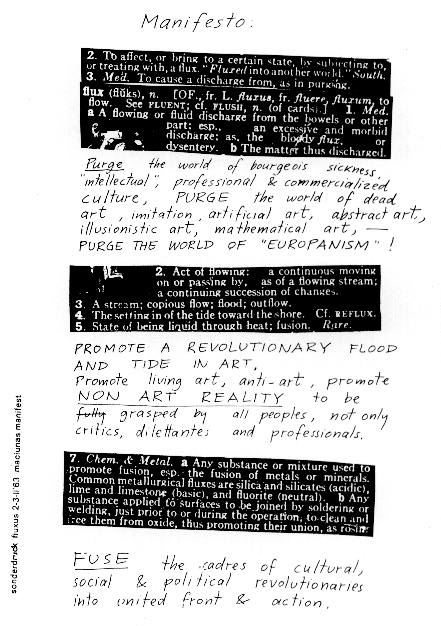
Artists have often been on the edge of contemporary practices, take for example Joseph Beuys, a German whose career revolved around expanding and opening up a dialog on the concept of Art, communicating through a series of ‘actions’ and public discussions. He was an artist who projected his work and ideas well beyond the sphere of ascetics and the boundaries of museums and art academics. He argued instead that all areas of human activity, whether social, political, economic. or spiritual, fall within the parameters of artistic activity. Art and the creativity within all humans was presented by Beuys as the agency, ‘the power to achieve and transform’ (2)
 Fluxus
  Robert Smithson
 Kenneth Knowlton
Up until the 50’s in America, Art in America was traditionally about the practice of Fine Arts that is drawing, painting and sculpting as skills – the atelier system. A conceptual shift in Art appeared after WW2, parallel with the invention of digital technologies (Turing) and the striving for a new American identity. (Fluxus, Art as Process, computer art). The resulting shift in Art production meant that by the 60's and 70’s art and its practices had changed and theory was raised above the practice of making resulting in the discorporate, the conceptual and the idea becoming the essential. (Robert Hughes). This reaction to changes in science and society, the moving away form the aesthetic is shown by John Baldessari who produced a series of paintings from text-book sources where he began to use language not as visual material but as actual information, or Mary Kelly whose early politicized art works such as Women and Work: Documentation on the Division of Labor in Industry (1975) employed conceptualized and process-based strategies intensifying her complex installations. John Baldessari
  Mary Kelly
As we turn into another century the blurring of media, technology, design, art, spectator, participator, theory and practice becomes a large part of the Artistic dialog. Barbara Kruger’s text and graphic imagery forces the spectator to imagine a response to her mediated messages, which were placed on billboards, bus cards, posters, media shelters etc. (site examples) Kruger’s pieces are about the spectators temporary interpretation at a particular transitory moment. The spectator completes the narrative, and as she states “ I am trying to interrupt the stunned silences of the image with the uncouth impertinences and uncool embarrassments of language’ Barbara Kruger creates an imagined knowledge that the spectator completes with or without consciousness (Lacan) Hasan Elahi documents his life in fear of being deported from America after 9/11 - a knowledge of surveillance. My art is not only about the disease of Precocious Puberty, but it is about placing Art in the public sphere, about involving the community in the process of Art, it is an academic production of theory and Knowledge through Performance and Practice? Knowledge is being created through technology, action and social relations and these cannot be separated. (Marshal McLuhan)
| To: | pumpkin@mindspring.com | ||
| Subject: | thoughts on precocious puberty project | ||
| Date: | Jun 6, 2007 12:17 PM | ||
When Angela asked me if she could film the kids for her thesis, I was eager to help and was interested in what she was doing. My kids were excited to be filmed and had no idea what the subject was. Angela did not give me many details of her project until the day she came to my house to film. She showed up with a bag of organic apples. When she began explaining what precocious puberty was I was taken back because I had dealt with this issue with my daughter when she was five years old. I had never heard the term “precocious puberty”. The doctor had only told us it was early onset of puberty, probably due to genetics and/or hormones in foods. I was very curious about this project. We discussed the descriptive language the medical profession uses and how the term precocious puberty put the onus onto the child.
hope all is well. Call me Lisa


 Barbara Kruger
By situating my Art as the Process of Art, the Process of Documentation, the Process of community involvement and using the blog as my Paper, I am creating a conceptually relevant document that fulfills the Universities criteria for evidence of the Production of Knowledge and understanding of scholarship. Through my use of New Media and technology, I am creating interactive narratives as Art, that rely on the personification of language, generated with and through technology and social interactions. (hyperlinking) The spectator and reader are the participator. http://www.awillcocks.com/PP.html The multiple placements, the multiple viewings, the multiple experiences created from multiple projections, connections and placements, with radio transmissions, videoing, acting, performing, talking and walking I am creating a new knowledge around the Precocious Puberty child and the use of Art in the public sphere.
This alternate exploration of Art, theory, language, and resistance can “emerge(s) in non-canonical cultural forms-transforms our critical strategies. It forces us to confront the concept outside objects d’art or beyond the canonization of the ‘idea’ of aesthetics, to engage with culture as an uneven, incomplete production of meaning and value, often composed of incommensurable demands and practices, produced in the act of social survival” (3)
So how do I prove my project works conceptually and artistically. I sent out a public announcement through internet, mail and telephone inviting participation and observations. Not one from my Acedemic advisers came, but that was not the the point, they can now see 'proof of project' on the internet at Myspace, Youtube, Current TV and on my web site? My contention, that by becoming a part of everyday practices (de Certeau,) I can actively take Art into the public sphere. I walked a direct route with backpack, projector and radio transmitter in Long Beach, CA. through Home Depot, along streets, past pumping oil-rigs, to an emergency medical center for kids. Just me, and my support person, Pearl who documented the experience with video. The people it affected the most were those who just happened to be where I was projecting. The everyday person was my target audience not the ones invited from Art and Academia but those who do not normally come into contact with alternate forms of expression. This was the evidence I needed, the evidence that I was finally creating a space for everyone and anyone.


As I complete this project what became apparent was the difficulty of shifting between disciplines and social places. I was starting to move between the worlds of Art and technology, Artifact and Activism, theory and Practice, without compromise. My art practices is about the technology, the Artist, the public, private, the interpreted symbol, the truth, the aesthetic and the content, the evidence of knowledge production and the artistic experience. They all have power, which produces a texualization of language, always overlapping the other. This inherent problem in presenting this project as scholarship is the obvious intellectual disregard of the practice and process of Art as knowledge production. This already existing phenomena created socially is indicative of the inherent problems in cross disciplinary practices - the defense and superiority of particular techniques and processes that are entrenched in a disciplines practice limits communication presenting initial obvious problems with ‘the written paper.’ Opportunistically I am proposing that by challenging and adopting alternate practices there is a “production of knowledge”.
NOTES
Capitalization:I use the Capital letter of A in Art or K as in Knowledge to give a sense of legitimacy and authority the the words placing the word above others in context and content!
Hyperlink: Hyperlinking is the action of clicking on an object that virtually links information and ideas. It can be a navagation tool a data network as well as a concept or narrative.
ACE - Arts Computation and Engineering University of California, Irvine. Program overview
http://www.ace.uci.edu/
1. Kuber, George The Shape of TIme: remarks of the History of things Yale University Press 1962
25. Title: The postcolonial and the past modern- the location of culture Mladen Dolar p172. Author: Homi Bhabha, Publisher & Date: Routledge 1994 22 - 23. Title: Joseph Beuys The revolution in us Tate Gallery Liverpool Compiled and edited: Judith Nesbit Publisher & Date: Cox Rockliff, Liverpool. 1994
Ashmore, Malcom The Reflexive Thesis: Wrighting Sociology of Scientific Knowledge. With a Foreword by Steve Woolgar. 318 p. 1989 University of Chicago Press
2 Title: Joseph Beuys The revolution in us Tate Gallery Liverpool Compiled and edited: Judith Nesbit
Publisher & Date: Cox Rockliff, Liverpool. 1994
McLuhan, Marshall. Understanding Media: The Extensions of Man (Cambridge: The MIT Press, 1994),
3. Bhabha, Homi The postcolonial and the past modern- the location of culture Mladen Dolar p172.
Routledge 1994
de Certeau, Michel translated by Steven F. Rendall. 1984. The Practice of everyday life.,
University of California Press, pp34-35


No comments:
Post a Comment